
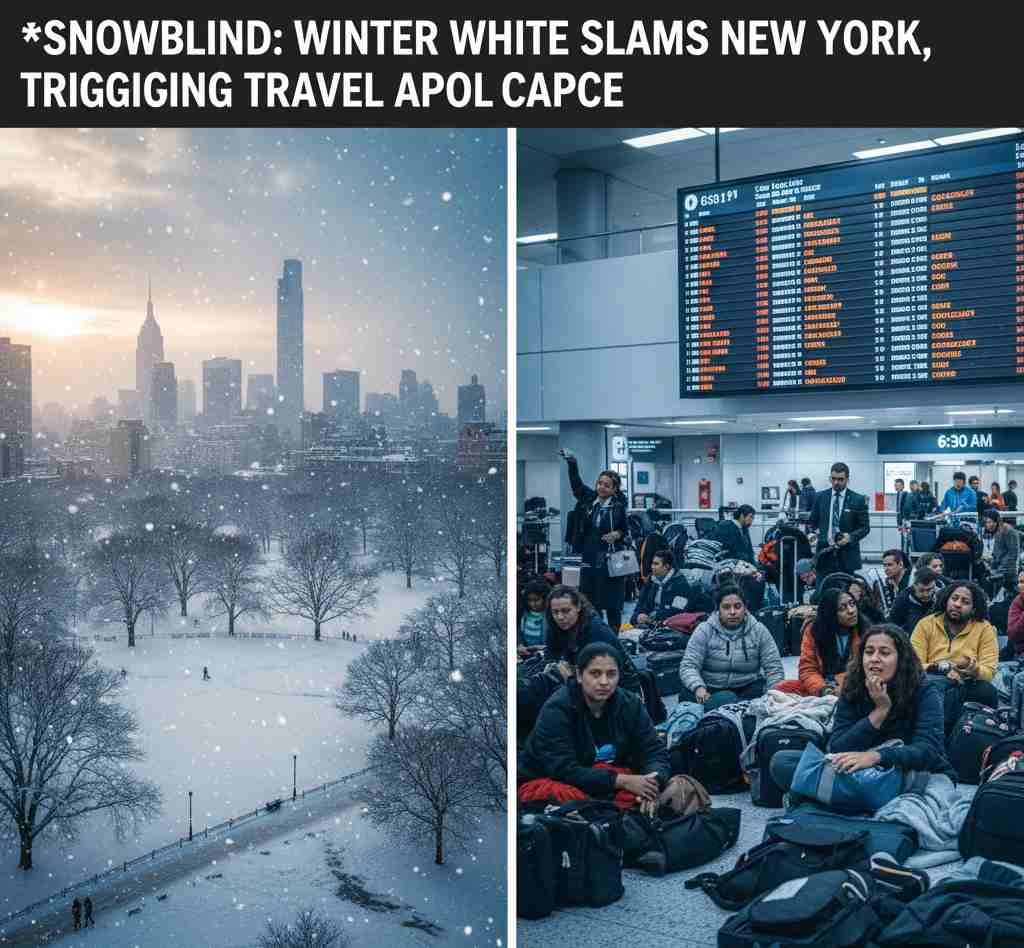

New Yorkers woke up this morning to a city transformed into a winter wonderland—but for thousands of travellers and commuters, the fairytale scenery has quickly turned into a logistical nightmare. The US North-east is currently reeling from its heaviest snowfall in nearly four years, as a powerful winter storm swept across the region, burying streets, grounding flights, and forcing officials to hit the panic button.
From the iconic skyline of Manhattan to the suburban stretches of Long Island, the “Big Apple” has been effectively blanketed in white. While the city is no stranger to cold snaps, the sheer intensity of this weekend’s dump has caught many off guard, marking a significant break from the unusually mild winters of recent years.
Central Park’s Record-Breaking Morning
According to the US National Weather Service (NWS), the snowfall totals are the highest the city has seen since January 2022. In Central Park, the official measuring point for New York City’s weather, 4.3 inches (11cm) of snow was recorded by early Saturday.
While that might sound manageable to a seasoned mountain dweller, in a city of eight million people reliant on precise transit timings, it was enough to bring the “city that never sleeps” to a grinding halt. Other parts of New York State saw even more dramatic figures, with some areas reporting a staggering 7.5 inches of fresh powder.
The regional impact was even more pronounced:
- Connecticut: Fairfield County bore the brunt of the storm with 9.1 inches recorded.
- New Jersey: High snowfall triggered an immediate state of emergency as local authorities struggled to keep motorways clear.
- Syracuse to Long Island: A broad corridor of the state saw a consistent 6 to 10 inches of snow.
State of Emergency: The Governor’s Warning
Anticipating the severity of the system, New York Governor Kathy Hochul took the preemptive step of declaring a State of Emergency for more than half of the counties in the state. The declaration is more than just a warning; it allows the state to deploy emergency equipment more rapidly and gives officials the power to close roads if conditions become too lethal.
“This is a serious storm, and we are treating it as such,” a spokesperson for the Governor’s office stated. Residents were urged to stay off the roads to allow snowploughs and salt spreaders to do their work, though many found themselves stranded before they even left their driveways.
Travel Chaos: Flight Cancellations and Stranded Passengers
The most visible sign of the storm’s impact was at the region’s major aviation hubs. For those hoping to fly home for the holidays or escape the cold, Saturday was a day of frustration.
According to the tracking website FlightAware, nearly 700 domestic flights were cancelled outright, with the vast majority concentrated in the New York metropolitan area. Another 3,000 flights across the United States were delayed as the ripple effect of the North-east’s weather gridlock spread to major airports in Chicago, Atlanta, and Los Angeles.
At LaGuardia Airport in Queens, images showed hundreds of passengers camped out on suitcases, staring at screens filled with the dreaded red “Cancelled” text. Similar scenes played out at JFK and Newark, where ground crews worked tirelessly to de-ice planes in sub-zero temperatures.
Code Blue: Protecting the Vulnerable
While the snow makes for beautiful photography, the drop in temperature that accompanied the storm is life-threatening. As the mercury plummeted well below freezing, New York City activated its “Code Blue” protocol.
Under Code Blue, the city’s social services are mandated to bring every homeless person into a shelter or hospital to prevent deaths from hypothermia. Police and outreach teams have been patrolling the subways and parks to ensure that no one is left exposed to the elements.
The hazardous road conditions also led to a spike in minor traffic accidents. Despite the storm’s peak passing by Saturday morning, the NWS warned that the “black ice” left behind on the tarmac is often more dangerous than the snow itself.
A Tale of Two Coasts: Mudslides in the West
As the East Coast digs itself out of the snow, the West Coast is facing a disaster of a different kind. While New York freezes, California is currently counting the cost of what experts are calling the worst winter storm to hit the south of the state in recent memory.
Instead of snow, California has been hit by torrential “atmospheric river” rains. The deluge has triggered devastating rivers of mud and debris, particularly in hilly areas where cars were seen buried up to their roofs in sludge. The contrast highlights a weekend of extreme weather across the entire North American continent, leaving infrastructure on both coasts strained to the breaking point.
What’s Next for New Yorkers?
Forecasters say the worst of the precipitation has moved out into the Atlantic, but the “Big Freeze” is far from over. Winds are expected to pick up tonight, creating significant wind-chill factors that will make 4 inches of snow feel like a deep-winter blizzard.
For the residents of the North-east, the rest of the weekend will be a slow process of shovelling, de-icing, and waiting for the flight schedules to return to normal.