

If you felt like you reached for the sunglasses more than the umbrella this year, you weren’t imagining it. With a fortnight still left on the calendar, 2025 has officially been crowned the sunniest year in UK history.
According to the latest Met Office figures, the nation has enjoyed a staggering 1,622 hours of sunshine so far, comfortably eclipsing the previous record set back in 2003.
A Spring to Remember
The record-breaking run was fueled by a “bumper” spring and summer. High-pressure systems effectively acted as a weather “lock,” pushing away the clouds and keeping the skies clear for weeks at a time.
Mike Kendon, a senior scientist at the Met Office, noted that the year was defined by “long spells of largely unbroken sunshine,” with only February and October failing to meet their usual quotas.
However, the “sunshine lottery” wasn’t won by everyone:
- England: Celebrated its brightest year on record.
- Scotland: On track for its second-sunniest year ever.
- Wales: Currently sitting in sixth place.
- Northern Ireland: Despite being warmer than average, it failed to even break into the top ten.
The Big Mystery: Why is it Getting Brighter?
Believe it or not, the UK has been on a brightening trend since the 1980s. While it’s tempting to point at climate change, scientists say the evidence isn’t quite there yet.
Instead, experts are looking at two main theories:
- Cleaner Air: Thanks to clean air laws, there are fewer “aerosols” (tiny pollution particles) in our atmosphere. These particles usually help clouds form; fewer particles mean thinner clouds and more direct sunlight reaching the ground.
- Natural Luck: It could simply be “natural variability”—a lucky run of high pressure that might eventually flip back to the grey skies we’re famous for.
The UK’s Solar Leaderboard (2025)
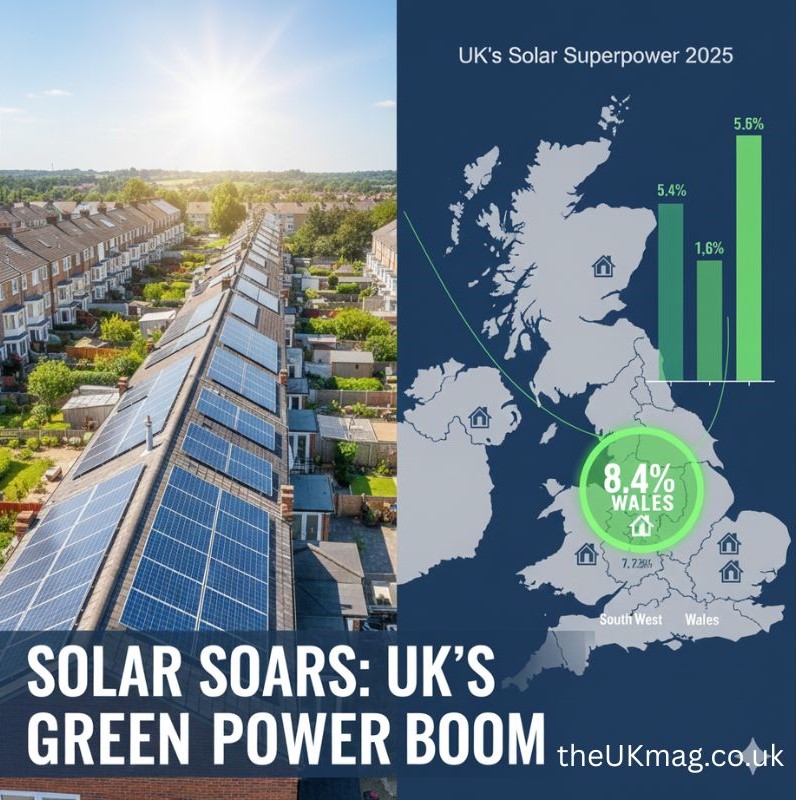
The latest figures from the MCS (Microgeneration Certification Scheme) and government data reveal a fascinating regional divide. While the sunnier south still dominates, northern regions are catching up fast.
| Region | Percentage of Households with Solar | Top Local Authority (Hotspot) |
| South West | 8.5% | Cornwall & Somerset |
| Wales | 7.2% | Anglesey (Ynys Môn) |
| East of England | 6.7% | Peterborough |
| North East | 5.4% | County Durham |
| Scotland | 5.0% | Stirling & Aberdeenshire |
| Greater London | 1.6% | Hornchurch & Upminster |
Key Takeaways from the 2025 Surge
- The “Anglesey” Effect: Interestingly, the single highest density of solar panels in the entire UK isn’t in a southern English county, but in Anglesey, Wales, where nearly 8% of residents have gone solar.
- London’s “Flat” Problem: London remains at the bottom of the league table. This isn’t due to a lack of sun, but rather the high number of flats and renters who don’t have the right to install panels on shared roofs.
- The New-Build Boom: Roughly 35% of all installations this year were on brand-new homes. Developers are pre-installing solar to meet the “Future Homes Standard,” which effectively makes panels mandatory for new builds by 2027.
- North vs. South: While the South West and South East have the most “sunny day” potential, the North East is now slightly above the national average for adoption, proving that you don’t need Mediterranean weather to make solar pay off.
Why 2025 was Different
This year saw a 122% surge in battery storage installations alongside solar panels. British homeowners are no longer just “generating” power; they are storing it to use after the sun goes down, further insulating themselves against high energy prices.
Solar Power Steals the Show
All that extra light has been a massive win for the UK’s energy grid. Combined with a surge in new solar farms and rooftop panels, solar energy generation has skyrocketed.
By November, the UK had already generated 18TWh of electricity from the sun—shattering last year’s total of 14TWh. This surge is doing more than just hitting green targets; it’s helping to pull down electricity prices by reducing our reliance on expensive gas.
“Renewables now produce around 60% of our electricity—a massive jump from just 3% at the turn of the millennium.” — Craig Dyke, NESO
The Perfect Partnership
While some local communities have raised concerns about the “eyesore” of large solar farms on the landscape, experts argue they are vital teammates for our wind farms.
Data from the Ember thinktank shows that 98% of the time, it is either windy or sunny in the UK. When the winter gales die down, the summer sun picks up the slack, creating a reliable, year-round green energy machine.