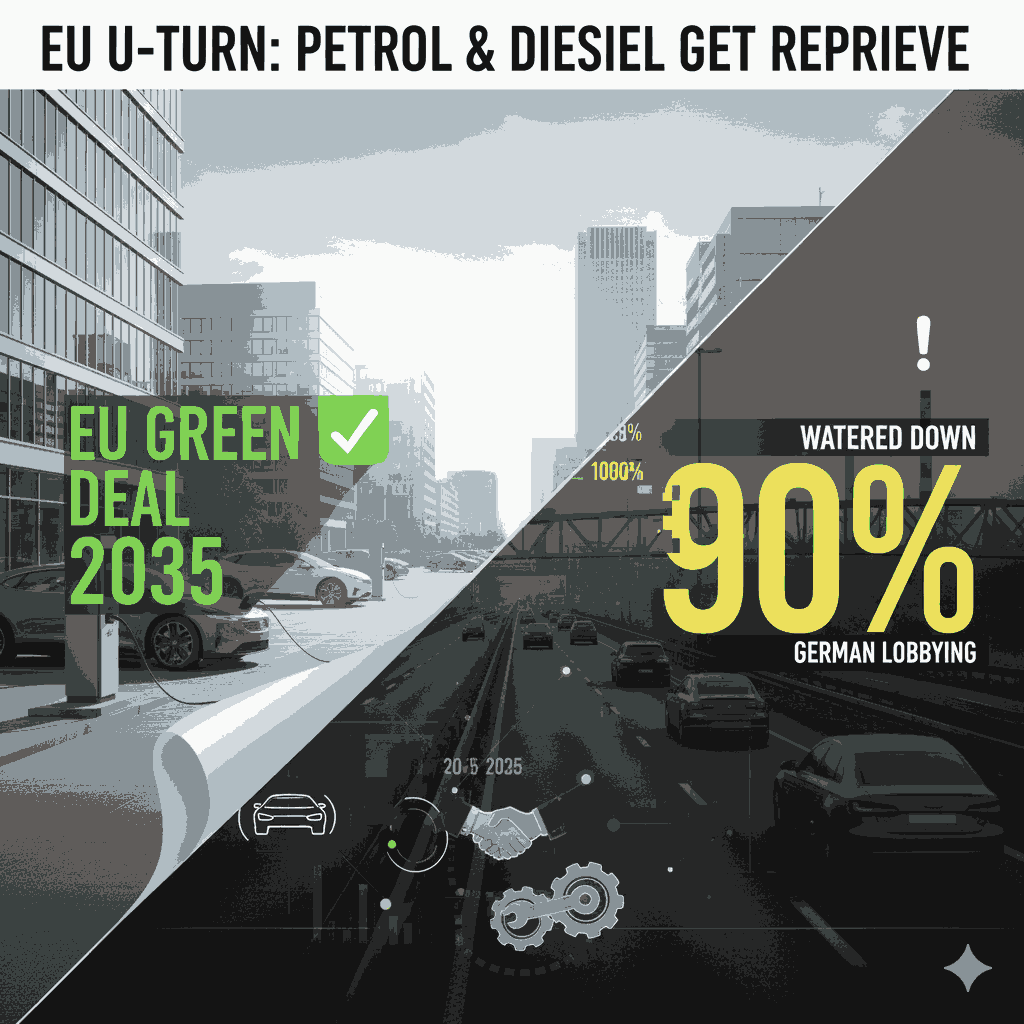

In a move that has sent shockwaves through the automotive world, the European Commission has significantly watered down its flagship plan to end the sale of new petrol and diesel cars by 2035.
While the original rules demanded a 100% shift to “zero emission” vehicles, a fierce lobbying campaign—led largely by German and Italian car giants—has forced Brussels to blink. Under the new plans, the target has been slashed to 90%, leaving the door open for internal combustion engines to stay on the road for much longer than expected.
The 10% Loophole
The remaining 10% of the market will now be allowed to consist of conventional petrol and diesel cars, alongside hybrids. To offset the environmental impact, the Commission is banking on a surge in “e-fuels” (synthetic fuels made from captured CO2) and biofuels.
Manufacturers will also be expected to use low-carbon steel produced within the EU for these vehicles, a move designed to support local industry.
Why the Sudden Change?
The European carmakers association, ACEA, warned that current demand for electric cars is simply too low. Without this “breathing space,” manufacturers faced the terrifying prospect of “multi-billion euro” penalties.
Sigrid de Vries, director general at ACEA, said the situation was urgent:
“2030 is around the corner, and market demand is too low to avoid the risk of multi-million-euro penalties. It will take time to build the charging points and introduce incentives to get the market on track.”
A Divided Industry
Not everyone is happy about the U-turn. While Volkswagen welcomed the move as “pragmatic” and “economically sound,” others fear it’s a step backwards.
- Volvo, which has already built a full electric portfolio, argued that weakening long-term goals for “short-term gain” risks undermining Europe’s competitiveness for years to come.
- Green groups like T&E warned that the move leaves the EU exposed to foreign competition, particularly from China, which is racing ahead with cheaper electric tech.
Should the UK Follow Suit?
The big question now is whether the UK will stick to its guns. Britain’s Zero Emission Vehicles (ZEV) Mandate is currently stricter, and experts are warning the government not to blink.
Anna Krajinska, director of T&E UK, urged the government to stand firm: “Our mandate is already driving jobs and investment into the UK. As major exporters, we cannot compete unless we innovate, and global markets are going electric fast.”
However, British carmakers have already been calling for better “sweeteners” to help drivers make the switch, with some fearing that a policy gap between the UK and the EU could lead to confusion for both manufacturers and buyers.